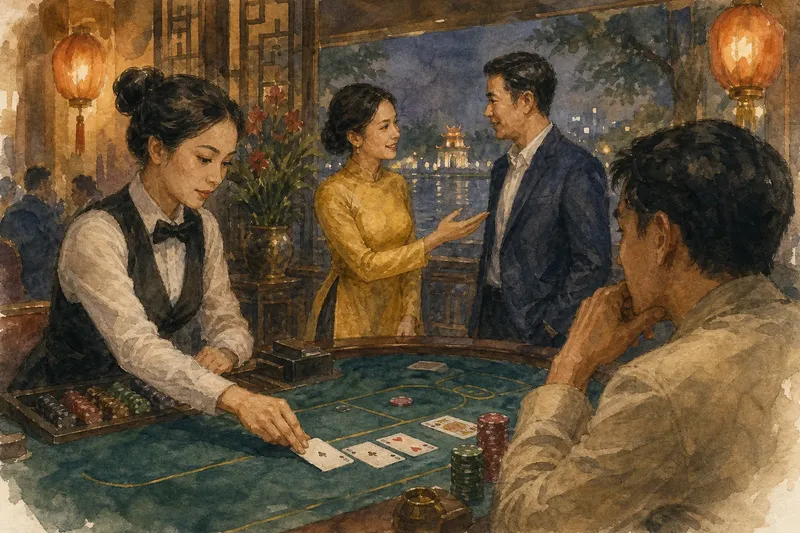
How Writers Use a Casino as a Fictional Setting
See how a casino as a fictional setting can give a plot a specific turning point, linking a character’s arrival to a choice that changes what follows.

A character slips a folded note into a coat pocket just as the person it names leaves a casino with a stranger. In fiction, a casino as a fictional setting can bring that missed meeting, the note and its consequences together in one scene.
The setting becomes distinctive through the plot it makes possible, not through a single symbolic meaning. A writer might use a casino for a chance encounter, a failed plan or a public conversation that one character hoped to keep private. The useful question is what the scene would lose if it happened elsewhere.
What makes a casino useful to a plot?
A casino can plausibly bring people with different purposes into the same venue. One character might be searching for a former colleague, another might be meeting a relative, and a third might be finishing a shift. Their motives need not match for their paths to cross.
That intersection matters when it changes what someone can do. An intended private conversation may become public; a character may meet an unexpected witness; or a delayed arrival may make a planned exchange impossible. The plot gains force from those specific consequences, not merely from the room’s appearance.
Give each character a reason to arrive before their plans collide.
How does the venue alter a character’s options?
A setting shapes a scene when it affects the choices available. A crowded public room, a doorway, or a staff-only area can influence whether a character approaches someone, waits, speaks openly or leaves. The detail matters only if it changes an action or its consequences.
Imagine a fictional scene in which a courier arrives with a letter intended for a guest who is seated beside the person the courier hoped to avoid. The courier can hand over the letter in view of both guests or leave without delivering it. If the courier hands it over, both guests can read the address and recognise the concealed connection; if the courier leaves, the message remains undelivered and the planned meeting fails. The venue’s public arrangement has made the choice visible and difficult to reverse.
Connect each notable feature of the room to a choice it changes.
How can one casino scene reshape a relationship?
A brief exchange can change trust, authority or distance between characters. A character who gives someone an introduction may signal loyalty; one who refuses to answer a direct question may deepen suspicion. The next scene can show whether that moment had lasting weight.
Say a fictional story begins with two siblings entering a casino together, while the younger sibling carries a family letter they have concealed. The older sibling asks about the envelope; the younger changes the subject, then leaves with it still hidden. The observable result is that the siblings part without resolving the question, and the older one has a new reason to doubt them. The letter’s continued concealment gives a later scene a concrete conflict to develop.
Track the specific action that changes what one character believes about another.
What questions clarify the casino’s role?
Why do the characters arrive there?
Identify each person’s immediate purpose, whether the story states it or reveals it through action. If those purposes bring them into conflict, the venue is helping arrange the plot.
What can happen here that would change elsewhere?
Look for an encounter, interruption or choice that depends on this particular scene. If moving the event elsewhere would change who witnesses it or what the characters can do, the setting has a narrative function.
What consequence carries into the next scene?
Follow the meeting into a changed plan, relationship or understanding. If nothing carries forward, the scene may chiefly establish mood or introduce a character.
Does the character behave differently after leaving?
Compare the character’s actions before the visit with what they do afterwards. A continuing change can signal a developing arc, while a return to old behaviour may make the scene’s effect temporary.
How can you tell whether a casino is more than a backdrop?
Consider an invented scene with a clear starting point: a guest arrives carrying a sealed envelope meant for a particular person. The writer can test the venue’s narrative role by tracing what happens to that envelope and who learns about it.
- The guest enters intending to deliver the envelope privately. Record that intention as the starting condition.
- The intended recipient appears with a companion. The guest now has a choice: deliver it in front of the companion or wait.
- The guest waits, but the recipient leaves before they can speak. The envelope remains undelivered, so the original plan has failed.
- The guest sends a message asking for another meeting. If the recipient agrees, the story can stage a later conversation; if the recipient refuses, the guest must decide whether to reveal the letter’s contents by another route.
In this invented sequence, the venue matters because the public encounter and missed timing alter the delivery plan. If the same chain of events could occur unchanged in a different location, the casino is functioning more as scenery.
- Check whether the characters arrive with different purposes. If those purposes collide, follow the resulting conflict; if they do not, identify another reason their meeting changes the plot.
- Check whether the public setting affects what a character can say. If an audience makes them hold back, track the withheld information; if privacy has no effect, look for another setting detail that changes an action.
- Check whether a specific feature of the room blocks or enables a choice. If it alters the available action, connect it to the consequence; if it changes no choice, treat it as atmosphere.
- Check whether the encounter changes trust or distance. If a character’s view of another shifts, follow that belief into a later scene; if it does not, look for a different consequence.
- Check whether a character’s changed behaviour continues after leaving. If it does, consider how the scene contributes to a longer character arc; if it stops, treat the behaviour as a temporary response.
- Check whether the next event depends on this meeting. If it does, the casino has helped shape the plot; if it does not, decide whether the scene chiefly supplies mood or context.
To understand a casino as a fictional setting, name the action, interruption or decision that would change if the scene took place elsewhere. That answer helps distinguish a venue that moves the story from one that simply surrounds it.